



















Keeping bias out of a review is hard enough work; harder still when tasked to review Resident Evil 5 whilst you consider yourself to be one of the world’s biggest Resident Evil fanboys. If you’ve ever dreamt of reading a review where the writer is constantly worried if he’s being too easy on a game and spends hours thinking of flaws to balance it out, dream no longer, gentle (Cool) Shite readers — this is that review!
Resident Evil 5, released by Capcom, follows Chris Redfield of Resident Evil and Resident Evil: Code: Veronica fame, now working on behalf of the Biohazard Security Assessment Alliance (or BSAA) on-mission in Kijuju, Africa. Teamed with Sheva Alomar, a member of the BSAA West African branch, Chris and his partner are ordered to investigate a new bioterrorism threat, which largely has come about to the fact that many viral creations of the now defunct Umbrella Corporation are being sold to and used by the highest bidder for their own self-serving purposes. Chris and Sheva soon find that this latest threat has far larger implications than originally thought, as Chris begins to uncover the real origins behind Umbrella and their assortment of macabre creations.
What’s good about the game? What’s bad? Read on.

Thanks, partner!
In the past, fear in the Resident Evil series has come from its survival element; largely, you’re left to fend on your own whilst battling grotesque creatures. Whilst remaining terrifying, Resident Evil 5 avoids cheap scares (dogs breaking through windows, anyone?) and instead relies on new tension, largely created as a result of your new partnership with Sheva.
The introduction of your nubile yet deadly partner means players can team up with a friend and play the game co-op, or choose to play alone and let the game’s AI assist. Either way, Sheva’s presence makes you aware of how little ammo and healing items you initially possess, and more importantly, how dependant you are upon one another when you find yourself cornered and in “dying” status. Partnerships are a huge theme, not only in the game, but in the entire Resident Evil series; you’ve never truly been able to survive entirely on your own, and you certainly can’t survive without one another this time around.
While the computer AI isn’t too shabby, it’s not perfect; you’ll find yourself yelling at Sheva as she runs around in circles during boss-fights (which are varied and fun…the boss fights, not Sheva’s glitchiness), or uses too many healing items on herself as she repeatedly walks into oncoming streams of bullets in later levels. However, an AI-controlled Sheva can also prove to be invaluable as she can assist in difficult sections that you might not be able to figure out on your own (I’m largely referring to the last level here).
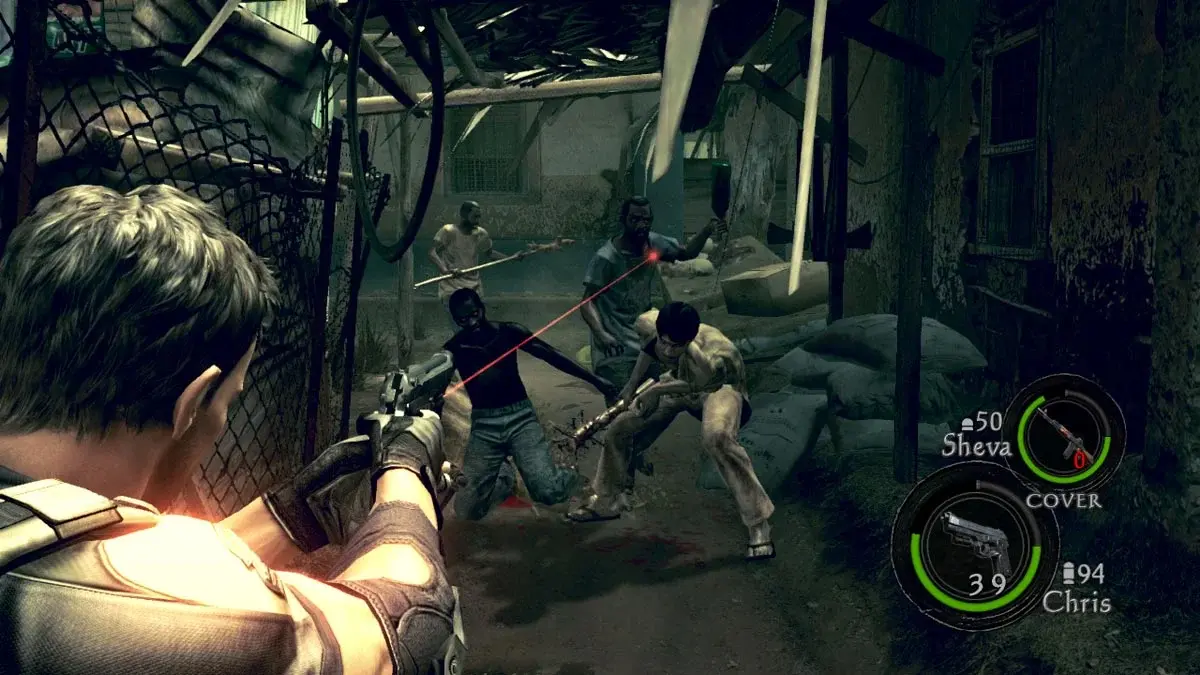
Playing with a human teammate can also increase the more mature, tension-inspired fear; if you stray too far apart, you may find yourself cornered by a huge number of enemies and not have the support you’ve unknowingly grown accustomed to, or you may not be able to make it back to your partner before he or she dies from a prolonged “dying” status.
The new inventory system builds upon the partner dynamic as well; it’s purposefully hard to use and frustrating to begin with until you realise the genius in how it affects your game. Inventory work is done in-game in real time, meaning you’ll have trust your partner to watch your back as you’re left defenceless choosing a new weapon to defend yourself, or pulling out a healing mix to keep both you and your partner alive.
Gears of Resident Evil, this ain’t
There have been limitless complaints about the controls of the game; many argue that Capcom’s decision to continue in the series tradition of having to stop to be able to shoot should have been abolished in today’s Gears of War-geared (pun intended) gaming. To those “hardcore gamers”: are you able to shoot a gun in real life whilst running with any precision? No; neither can our Resident Evil heroes. By Capcom forcing players to run to a position, set up shop, and then shoot, they’ve added a level of realism to the game that other titles cannot match.
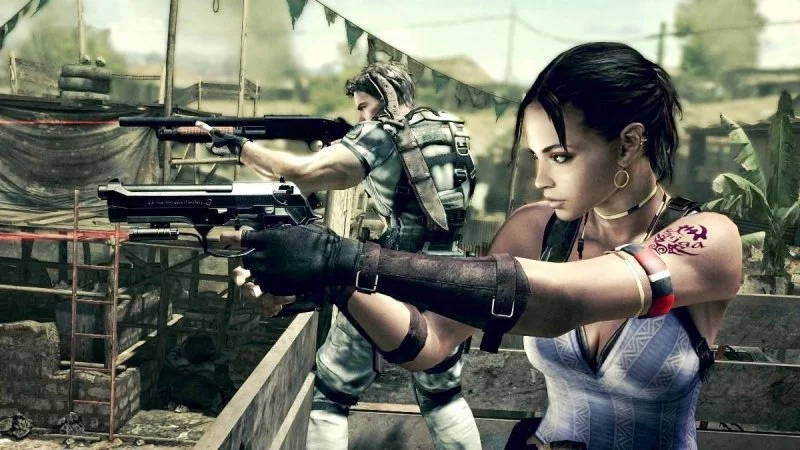
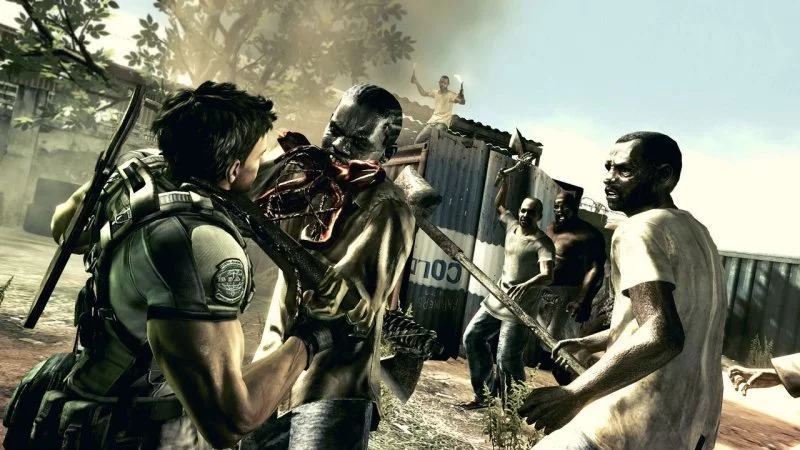
Another source of tension and fear comes from this mechanic; by stopping to shoot at the enemies coming from you at all angles, you’re constantly aware that a single Majini (the new African Las Plagas-infected) coming up from behind you, unseen, could mean your undoing.
The negative to balance out bias in the review? Easy: knife combat should allow for freedom of movement instead of the stop-and-fight gaming the series offers. Knife fighting should be fluid and is instead clunky and easily-abandoned in the course of gameplay. A word to the wise; you’ll find that melee combat is much easier (and very fun) to master: shoot enemies in the legs and kick them in the face to your heart’s content!
Two words: FAN. SERVICE.
Die-hard fans will love this game; sensing that fans weren’t too impressed with the off-screen demise of Umbrella in Resident Evil 4, Capcom has used this instalment of the game to tie together and resolve most of the series’ over-arching plot points. The scale of the story goes above and beyond epic proportions, and I found myself outright squealing through many of the game’s cut-scenes (another note: don’t squeal too much, or you may find yourself missing the loved-or-hated random button-presses required to keep you alive in some scenes).
On the topic of cut-scenes, and of general production values: Capcom has spared no expense. Voice actors were fitted with motion sensors to record facial movements whilst delivering dialog; those movements were then mapped to the CG characters for usage in-game. New 3D cameras were used to add a set of post-production tools never before seen to a video game, and the Twentieth Century Fox orchestra was used to record the game’s score. If you’re a true fanboy and want the full experience, make sure to pick up the Collector’s Edition of this game for a great behind-the-scenes making-of DVD.
Still, you may feel that these grandiose production values moved focus from a redefined Resident Evil experience that Resident Evil 4 truly was. Resident Evil 5 has come into homes today with a lot to live up to; 4 took the “survival horror” genre the series was so famous for and introduced many different gameplay mechanics that it was thought of as an “action horror” title instead. The series was flipped on its head; old fans either loved it or hated it, but a new group of gamers found the series for the first time and fell in love.
It’s true: instead of another revolution to the game series, Capcom has treated Resident Evil 5 simply as an evolution. Everything is beautifully rendered in next-generation console HD fashion, and with the exception of the new co-op dynamics, it’s a case of elements from 4 being improved or expanded upon. Fans of 4 will love this game because it’s familiar; fans of the series should find enough from the fan-servicing alone to be more than happy.
Is that enough? Is this appealing to the general public? Yes. There’s enough substance in the co-op alone to warrant a purchase, and with the series as strong as it is, a love for the game may mean a casual gamer gets drawn in and gets to discover the series through its vast library of past games and films. Replay value is also quite high with four levels of difficulty and a treasure trove of costumes, collectibles, and a separate mini-game to unlock. Capcom has also announced different multiplayer game modes as downloadable content available in the coming weeks.
This article may contain affiliate links, meaning we could earn a small commission if you click-through and make a purchase. Stevivor is an independent outlet and our journalism is in no way influenced by any advertiser or commercial initiative.