



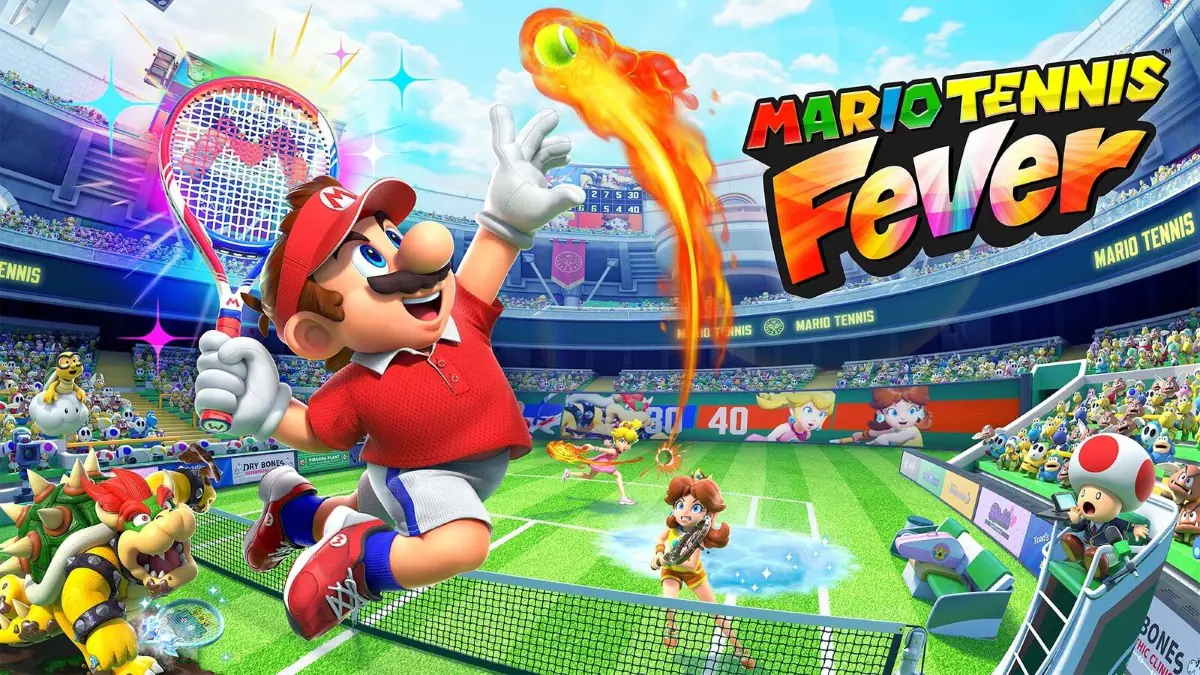

Mario's stranded as his baby self, and now he's rubbish at tennis. Mamma mia!
Mario returns to the court in Mario Tennis Fever after his deluge of Aces almost eight years ago, following a similar game plan. The single-player content remains light and fixates on a series of basic mini-games designed to teach newcomers the mechanics, while its greatest strength is reaffirming that a notoriously solo sport is best played with friends in the Mushroom Kingdom.
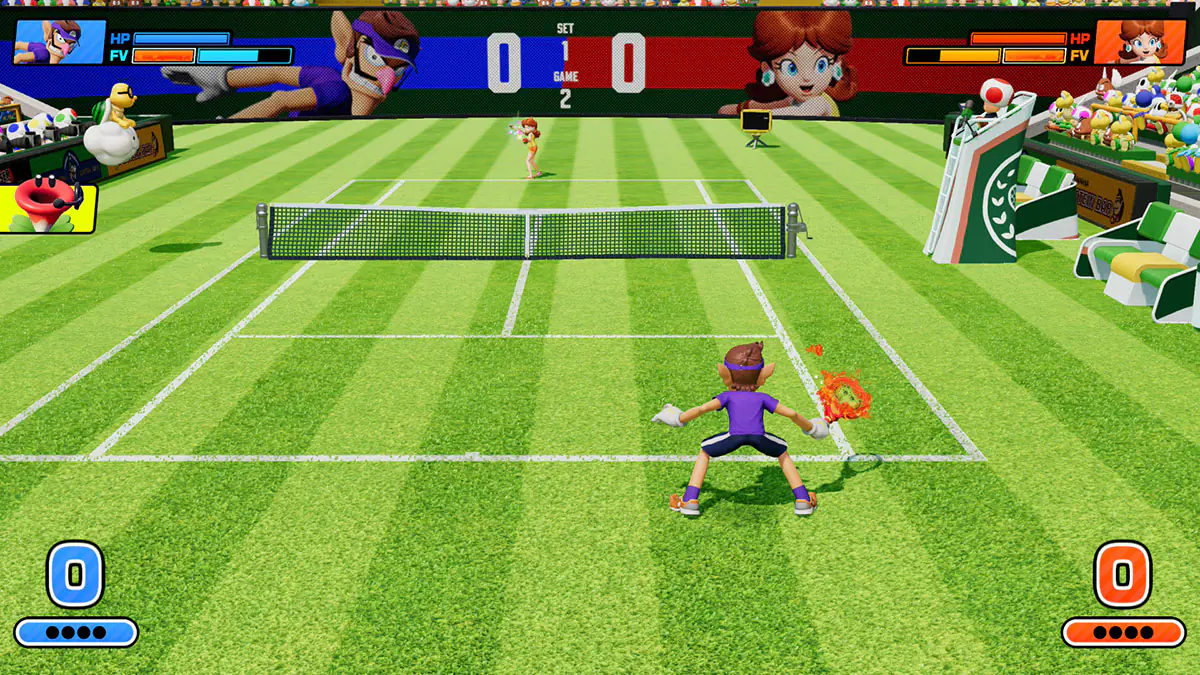
The new hook is the introduction of Fever Shots, which feel familiar to anyone who’s ever played a Mario sports game: fill the power bar to unleash a special ability. This time, however, it’s all about the lasting effects of the fever, which are tied to your racket. The shot itself is only marginally more powerful and can be stopped, but it also adds a temporary disruptor into the mix for the next few points. Think DK’s slippery bananas, startling lightning strikes, or blinding squid ink – all creating a brief window for your opponent to sneak the ball past.
While very similar to previous power-ups, Fever Shots allow for more two-sided play. As I said, they can be returned if you’re in the right position, and if you really nail the timing, you can even block the shot, sending the obstructions back across the court to give your foe a taste of their own medicine.
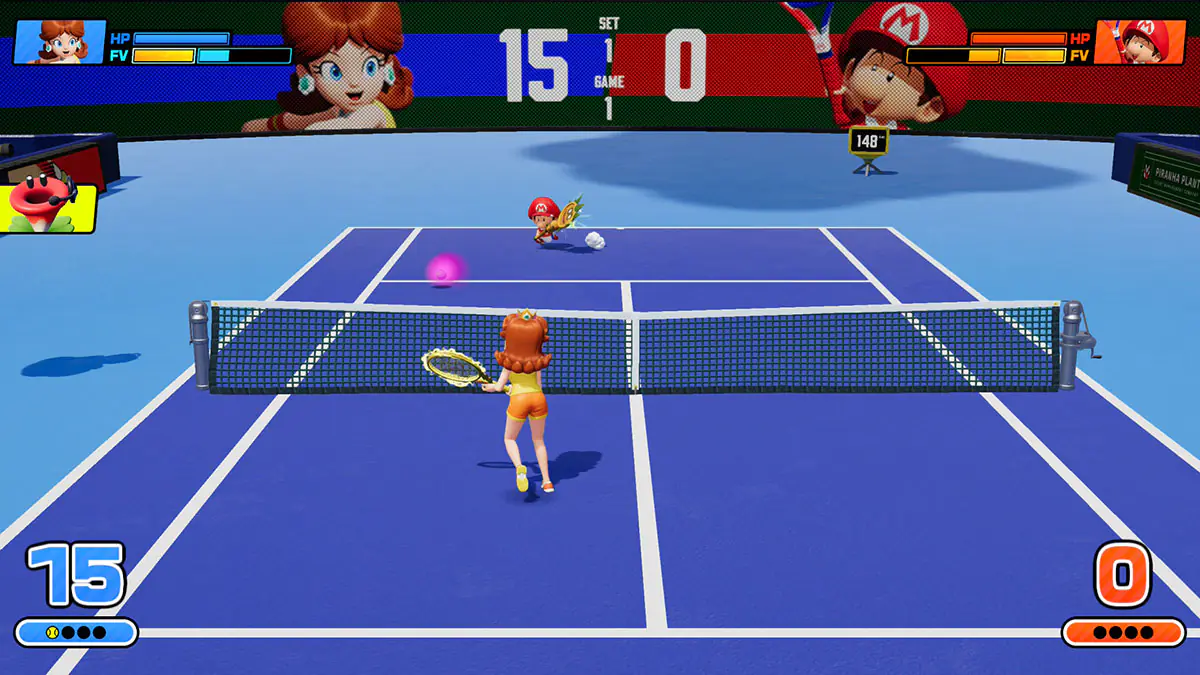
It also means Fever Shots aren’t an instant ‘win the point’ button, and for the next few shots, they change the dynamics for both players in attack and defence. Ultimately, while I normally disable Mario sports gimmicks when playing with friends, I liked Fever Shots enough to leave them on for a couple of multiplayer games, before turning them off so we could play real (Mario) tennis.
Whereas Mario Tennis Aces highlighted a renewed focus on single-player content, Mario Tennis Fever tries to capture the best of both worlds but is primarily a multiplayer game. It’s at its best in local multiplayer, when the novelties are stripped back to allow its excellent arcade tennis gameplay to shine against the challenge presented by a real opponent.
The menu screen spotlights that most modes can be played by up to four players, firmly keeping multiplayer in focus. New to Fever is the ability to share the game locally to other Switch 2, and even Switch 1, consoles with a single copy of the game, harking back to the glory days of DS Download Play.
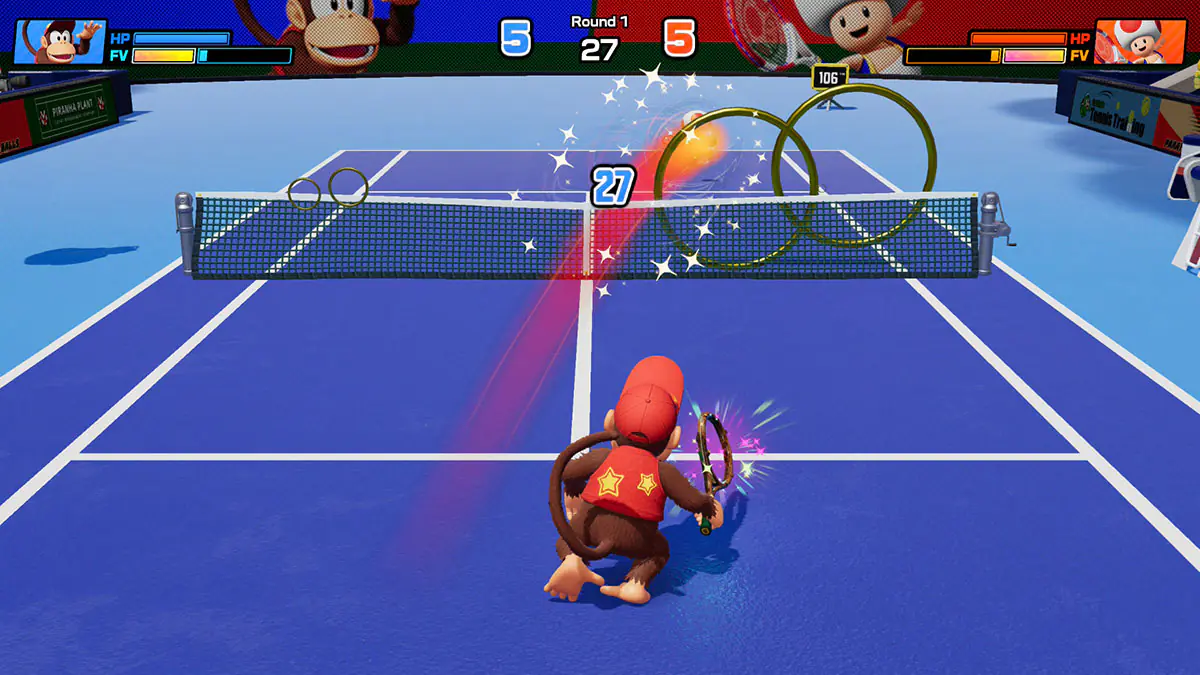
The tennis itself remains simplistically excellent. Beneath the novelty modes and quirky courts is a genuinely good arcade tennis game that does away with the intricacies that can plague tennis simulations. Player movement is smooth, and the blend of topspin, slice, and flat shots provides enough variety to enable meaningful tactics while still allowing almost anyone to pick up and play a match. There’s even a separate Wii Sports-inspired motion controls mode if you want to relive 2006. Shot selection matters, and most importantly, each return feels satisfying in the heat of an epic rally – against real players, that is.
Going it alone is where Mario Tennis Fever starts to break down. CPU players are too predictable, and higher difficulties mostly increase the likelihood of them making unbelievable returns from well outside the court. They employ similar tactics and have no real answer to the overpowered serve-and-volley play.
There’s also a lack of meaningful solo content. Tournament mode is woeful, offering just three cups that begin as two-game, one-set matches. If you’ve played Mario Tennis before, expect to waltz through the Mushroom Cup in about five minutes with little resistance. The other cups each add a set but don’t take much longer; do it again in doubles if you really want to. Trial Tower is much the same, only rapid-fire, tasking you with quickly defeating 10 players in even shorter matches. All up, even with a few runs, you’d be lucky to carve out more than a couple of hours across these modes.
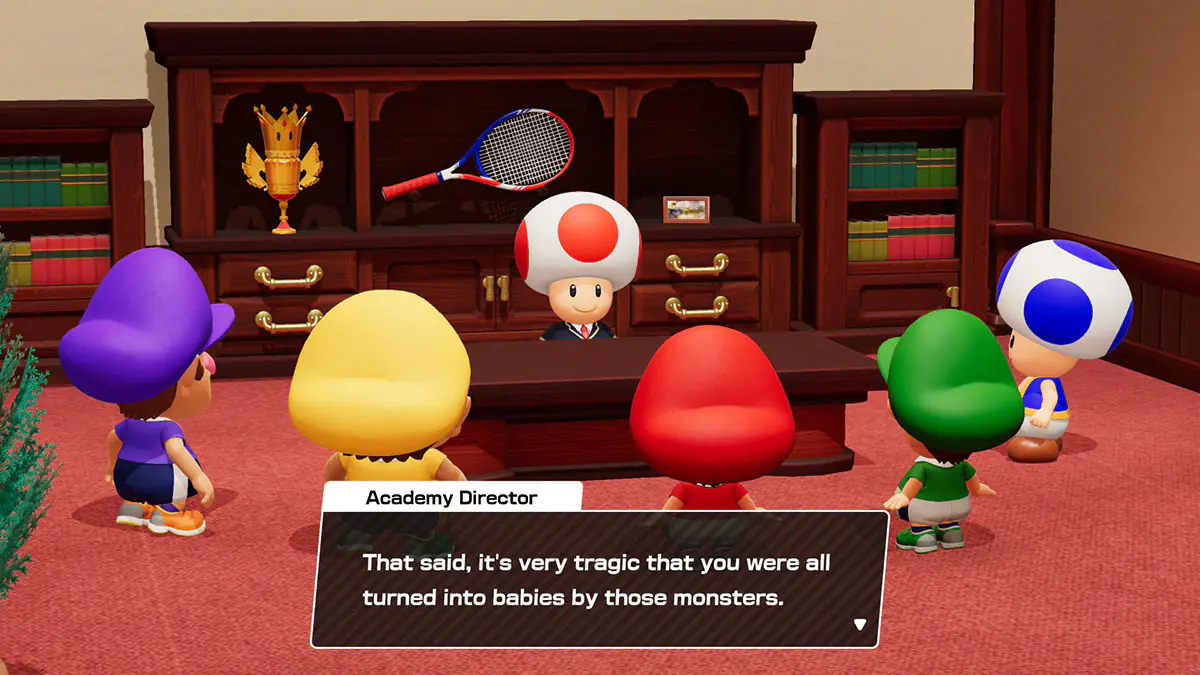
Much like Aces, Adventure mode anchors the package and attempts to introduce a new story. There’s no evil racket this time around; instead, Mario and Luigi – actually, the whole crew – have reverted to their baby selves and are now rubbish at tennis. Mamma mia!
Through a series of minigames, you’ll need to level up and rebuild Baby Mario’s tennis prowess. Guided by the very chirpy Talking Flower, these minigames are too shallow for my taste, and feel designed as much to pad out the runtime as they are to teach the skills of Mario Tennis.
Adventure mode is clearly aimed at newcomers, particularly younger kids encountering Mario Tennis – or even tennis in general – for the first time. There’s a place for that and it provides substance in gamifying learning the rules of the real-world sport many may go on to try – Mario Tennis 64 certainly helped me learn to score in real-life matches. But as someone who’s played Mario Tennis for many years, I found Adventure mode a boring grind. And without it, there simply isn’t enough single-player content in Mario Tennis Fever.
The similarities with its predecessor extend to Fever’s very existence as an early Switch 2 exclusive, just as Aces was on Switch. This time, though, the prior instalment remains a viable alternative thanks to full backwards compatibility. At AUD $30 more expensive than Mario Tennis Aces was in 2018 – and still is today on Switch 1 or 2 – it’s difficult to justify for more casual players who just want the occasional local hit with friends. That’s how Mario Tennis is best played, regardless of version, and the cheaper Switch 1 game delivers that experience just as well on Switch 2.
Mario Tennis Fever is also a letdown as one of the first Switch 2 exclusives. There’s little that feels truly current-gen, and some of the visuals are surprisingly basic and rough. It’s vibrant and colourful, as expected from a first-party Nintendo game, and performance is solid, but it isn’t popping in 4K with crisp court lines, and the Adventure world lacks substance and looks hastily assembled. Before his retirement, Doug Bowser touted variable pricing for Switch 2 games to justify Mario Kart World at AUD $120. If that strategy is genuine, Mario Tennis Fever feels like it fits the brief for a budget release – one that should have been priced much closer to the AUD $80 of Mario Tennis Aces.
Mario Tennis Fever continues to prove that tennis isn’t a solo game in the Mushroom Kingdom – it’s best played with friends. The tennis beneath the novelties are still great fun, and it pulls off a great Wii Sports impersonation on the side, but it’s lacking in single-player content and doesn’t do enough differently to the last-gen game, which offers a very similar experience for most Mario Tennis players at a lower cost on Switch 1 or 2.
Mario Tennis Fever was reviewed using a promotional code on Switch 2, as provided by the publisher. Click here to learn more about Stevivor’s scoring scale.
This article may contain affiliate links, meaning we could earn a small commission if you click-through and make a purchase. Stevivor is an independent outlet and our journalism is in no way influenced by any advertiser or commercial initiative.