













Returning to Metroid Prime’s unique form of action-adventure after 18 years is like riding a bike.
After a false start stretching back to E3 2017, Retro Studios returns with the first mainline 3D Metroid game since 2007’s Metroid Prime 3 Corruption. After such a long layoff, Nintendo’s clarified this is a new story that doesn’t infringe upon the completed Phazon saga of the original trilogy. That makes Metroid Prime 4 Beyond an excellent entry point for newcomers, while for those of us there on GameCube and Wii, it’s a nostalgic homecoming. Stepping back into this world after 18 years is like riding a bike – except when Samus is actually on one.
After so many years, Nintendo fumbled the morph ball with Metroid Prime 4’s marketing. It was barely acknowledged and showed little. I’m delighted to report that Prime 4 stays true to the tried and tested formula where it counts. Yes, Samus occasionally rides a motorbike now and is a minor celebrity amongst chatty NPCs, but this is very much a solo first-person action-adventure game that’s as much about exploration and puzzle-solving as blasting away enemies. Only this time there are a few more forays into third-person so Samus can pull-off the odd wheelie.
In many ways, Metroid Prime 4 feels like the sequel we might have played in 2011. It faithfully follows the genre’s blueprint Retro Studios created back in 2002. When pure first-person shooters were still finding their feet, let alone more ambitious 3D action-adventures that pushed beyond combat.

More than 20 years later, Retro has dusted off its own playbook and trusted in the timelessness of its design. As Metroid Prime Remastered proved, the formula still holds up astonishingly well; all that needed was a fresh coat of paint and twin-stick controls. While the 2D landscape of Metroidvanias is cluttered with successful homages, the 3D variant lacks quality imitators, so despite staying so close to the games that came before it, Metroid Prime 4 Beyond still feels fresh.
The game’s structure feels like a soft reboot. The world and gameplay design resemble the relative simplicity of the original Prime, while the non-playable character driven narrative leans closer to Prime 3. You’ll explore the familiar settings of forestry, volcanic caverns, icy peaks, electrical hazards, and mining tunnels. Despite a new open desert area connecting these locations, level design remains tightly curated: linear corridors brimming with secrets ripe for exploration and backtracking when Samus unlocks new abilities – in just the right dose so you feel clever upon remembering to return to a previously inaccessible area rather than exhausted.
As usual, Samus loses most of those abilities early on. Prime 4 weaves this into the story by positioning the returning skills, and a few new ones, as psychic powers. Functionally they’re almost identical to the classic Metroid abilities, only now in purple – a psychic jump is still a double jump. It’s a story-based explanation that resets and returns some of the intrigue of the original Prime by starting afresh as best it can. With familiar level design, themes and abilities to the game that started it all, there are shades of The Force Awakens to A New Hope.

The genuinely new powers, like the psychic glove and a remote-controlled psychic beam, add clever twists to puzzles but otherwise settle comfortably into the broader toolbox. The result is a beautifully balanced mix of combat, exploration and problem-solving with the odd tricky boss battle – and Metroid Prime still lays claim to the best first-person platforming of any series.
New abilities come at a rapid pace – you’ll rarely play more than 30 minutes without unlocking or enhancing something. As a veteran player, I’ve enjoyed returning to a familiar expedition. I often anticipated which returning ability would arrive next and pieced together the sequencing before it was presented. I suspect newcomers will find the pacing a little slower but still satisfying. It’s easier to follow and guides you along more than the previous entries. But it doesn’t hold your hand the entire way and still carries a sense of achievement.
That’s where Metroid Prime 4 Beyond takes its own turn to modernise and expand upon the otherwise faithfully recreated 2002 gameplay. Games have changed since the original trilogy launched, and for right or wrong, they’re frontloaded with lengthy tutorials. Metroid Prime 4 conforms to those expectations far more than the original games did; and while this is the weakest section of the game, it’s certainly not as bad as some previews made out.

The approach to storytelling follows Prime 3, with a cast of fully voice acted Galactic Federation soldiers joining Samus along the way. These characters push the plot forward but largely stay out of your way in gameplay; they’re rarely anywhere to be seen during critical moments when Samus continues to work alone.
It’s a little strange to have fully voiced cutscenes, only for Samus to stare blankly and remain mute, especially at critical junctions when she holds the key intel. She’s always done that in the Prime series, but her character has spoken in other games. It feels like a missed opportunity to fully embrace this direction and further develop Samus, rather than a bunch of forgettable nobodies.
The Federation allies do occasionally tag along or chime in with suggestions on where to go next over the radio, but they rarely comment on puzzle solutions. The isolation of the original game is gone, so it does feel different, but the trade off in atmosphere allows a more coherent narrative. While there are a few cringey comments, these characters are nowhere near as egregious as most PlayStation first-party sidekicks and their incessant commentary.
Prime 4’s biggest point of difference isn’t the chatter – it’s traversal between each self-contained area. This time around, the trusty ship is substituted for actively driving between them on Vi-O-La, a motorbike that integrates with Samus’ new suit. Whereas the timeless core Metroid gameplay feels like it could have arrived in 2011 in all the right ways, riding a bike through a barren open area also feels straight from the Wii-PS3 era, in all the ways we’ve since moved beyond.

Riding around collecting crystals in an otherwise empty sandpit is a decidedly B-tier addition to an otherwise AAA game. That said, I was ready to hate it after the awkward tutorial on a racetrack, but I grew to appreciate the change of pace. It’s nice to have a more open breather after being confined to enclosed corridors.
That was up until the push to the finish, when it forces some tedious grinding driving around the empty world you’ve already explored. That killed the affection I was developing for Vi-O-La in shorter bursts – it’ll clearly be shortened when Prime 4 is remastered on Switch 5. While there’s no fast travel, which may be Prime 4’s most alienating feature for novices, cruising around does make it easier to move between areas, without making it too quick. Metroid is about slowly retracing your steps, after all.
When you arrive into one of the areas, it’s straight back into first-person and classic Metroid Prime gameplay – that’s how you’ll spend most of your time. It controls just as you remember, especially for those familiar with the modernised scheme used in the Prime remaster. It is, however, a little simpler than the only other Prime game available on Switch.
Prime 4 uses a single arm cannon beam, mapped to ZR and A, which empowers it as the primary weapon and keeps it in play for the entire game. The elemental fire, ice and electric shots are handled as secondary weapons, which shares the R button with missiles. These are the four you’ll regularly switch between, with the difference being the secondary shots all use a more forgiving version of the ammo system introduced in Prime 2. Likewise, scanning is rolled into psychic visor so you’ll only need to swap between two views. These tweaks retain the essential Metroid Prime power-ups, but condense them into an easier to master arsenal.
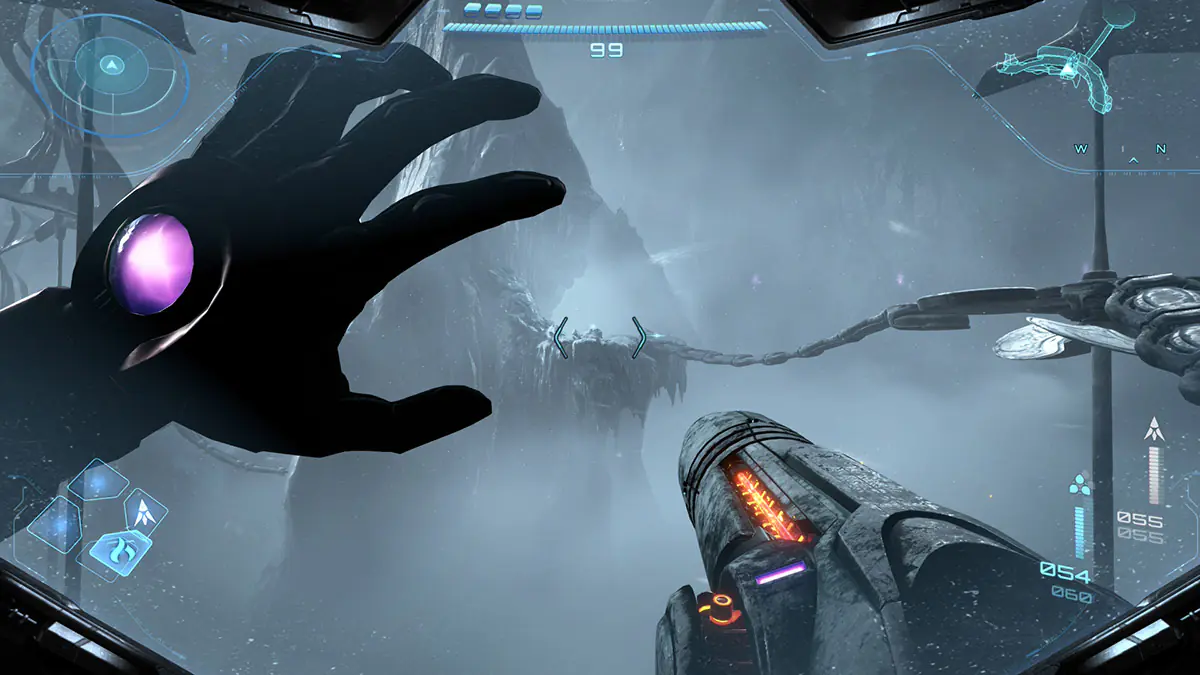
As a cross-gen game, Metroid Prime 4 Beyond looks good, and is very impressive for a game originally built for a 2017 handheld, but doesn’t amaze us as past instalments have. That allows it to prioritise performance and gameplay over cutting-edge graphics, essentially arriving with a day one remaster on Nintendo’s current-gen console, which looks much cleaner. It’s not until you go back to the Switch 1 version that you realise how much of a step up Metroid Prime 4 takes on Switch 2, which justifies its AUD $20 upgrade cost.
The Switch 2 Edition runs at a crisp 4K and silky smooth 60-frames-per-second – with the option to uncap the framerate at a lower resolution. There are a few rough textures and animations that stand out against the higher quality around them – almost like low-res textures from the Switch 1 version that missed the glow-up. But the key players all look good, and Metroid Prime 4 Beyond is clearly the best performing AAA game I’ve played on Switch 2 so far – this is a cross-gen game that’s worth upgrading your system for.
Metroid Prime 4 Beyond is a familiar return for the series and a soft reboot that introduces a new story and revisits the best parts of the original game that dazzled us two decades ago. It isn’t trying to reinvent Metroid Prime, rather bring it back for a new generation jumping in for the first time – and all these years later, there’s still nothing quite like it. The newer ideas – mute Samus contrasting with lively Federation characters and the Vi-O-La motorbike sections in an empty world – are the weakest parts. But they serve their purpose and the core of Prime 4’s package delivers the familiar tried and tested classic Metroid Prime gameplay for a new generation.
Metroid Prime 4 Beyond was reviewed using a promotional code on Switch 2, provided by the publisher. Click here to learn more about Stevivor’s scoring scale.
This article may contain affiliate links, meaning we could earn a small commission if you click-through and make a purchase. Stevivor is an independent outlet and our journalism is in no way influenced by any advertiser or commercial initiative.