





Stash space will make me god.
In-progress review [10 March 2026]: There’s calm to be found among the tension of those metallic footsteps. The cold, hard sound of a UESC bot patrolling a hallway. It’s a threat, sure. A wrong move and you’ll be knocked before you know what’s happening. As long as they’re there though, as long as their thump-thump-thump moves along the corridor, you’ve got some semblance of protection. An early warning. And so you rifle through loot containers until the quiet sets in.
An eerie stillness. Wrong, somehow. Your squadmates chatter away idly, but something feels out of place. There’s footsteps there still, though… they’re different now. Softer. Quicker. Runners. The call goes out but it’s too late. The fight breaks out, if you can even call it that. Your loot-gremlin Vandal, head stuck in a locker, is downed immediately. The Destroyer puts up a valiant fight, but is outflanked before you can find your way to them.
In a flash, you’re alone again. Just two knocked-out teammates and the soft pat-pat-pat of the enemy runners looking for you. They know you’re there, somewhere. It all happens so fast. A moments distraction and another squad will roll through you. Lock in on another team too hard and UESC bots will swarm and eat you alive. Resources are scarce, everything is a threat and a team wipe is just a heartbeat away. This is Marathon.
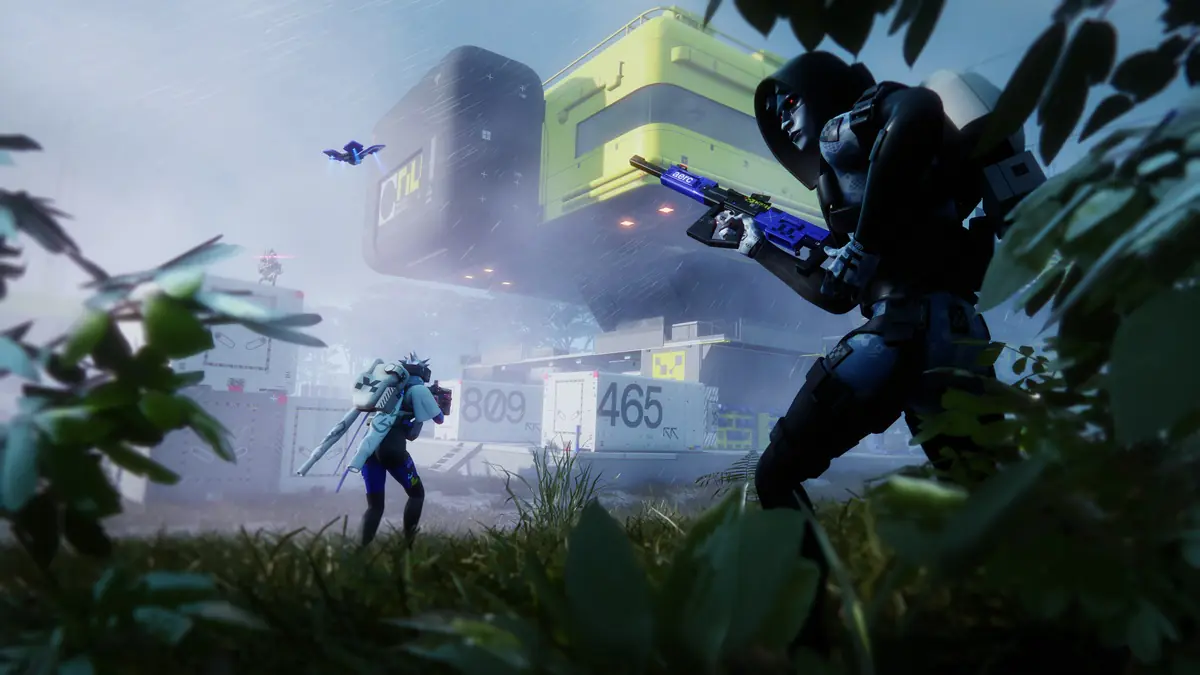
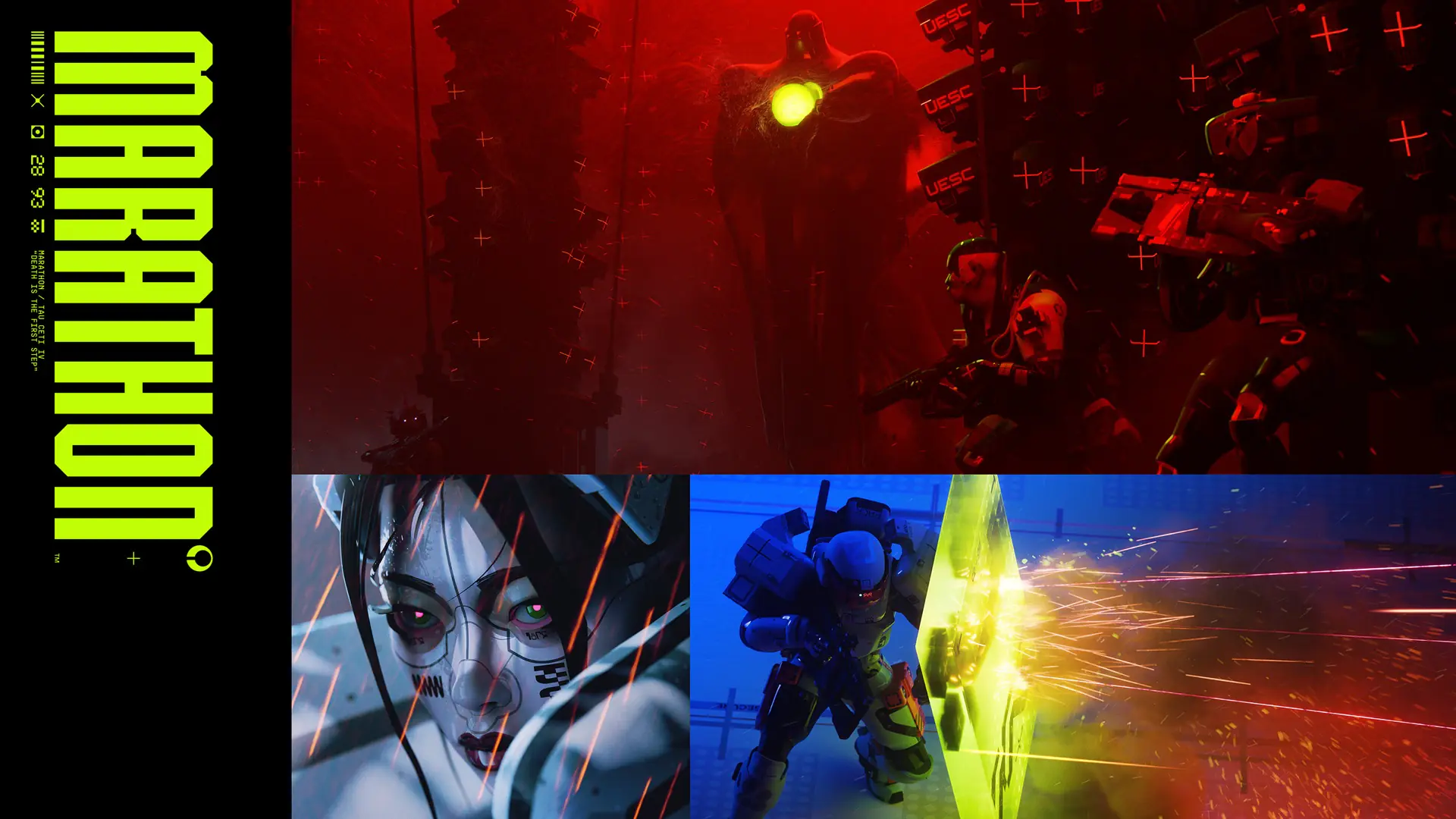
There was a time, not so long ago, when extraction shooters were considered niche. Now though, Bungie is launching its spin on the genre into a much more crowded room. Picking up quite some time after the events of the original trilogy, Marathon uploads you into biosynthetic shells and dumps you on to the ruins of Tau Ceti IV.
This colossal colony was once home to thousands, but now lays derelict. Buildings and other structures are in various stages of decay – both inside and out. Some are run down, with broken windows and messy interiors. Others, though, are pristine, as if their inhabitants had only just left. The world of Marathon seems almost locked in a moment, halfway between a soaring peak and a decrepit future.
To explore the remnants of this now-dead colony, you’re given your choice of six Runner shells – the aforementioned biosynthetic creations – or a much more traditional robot called the Rook. Each Runner features their own combination of traits and baseline stats, along with prime abilities and tactical abilities.
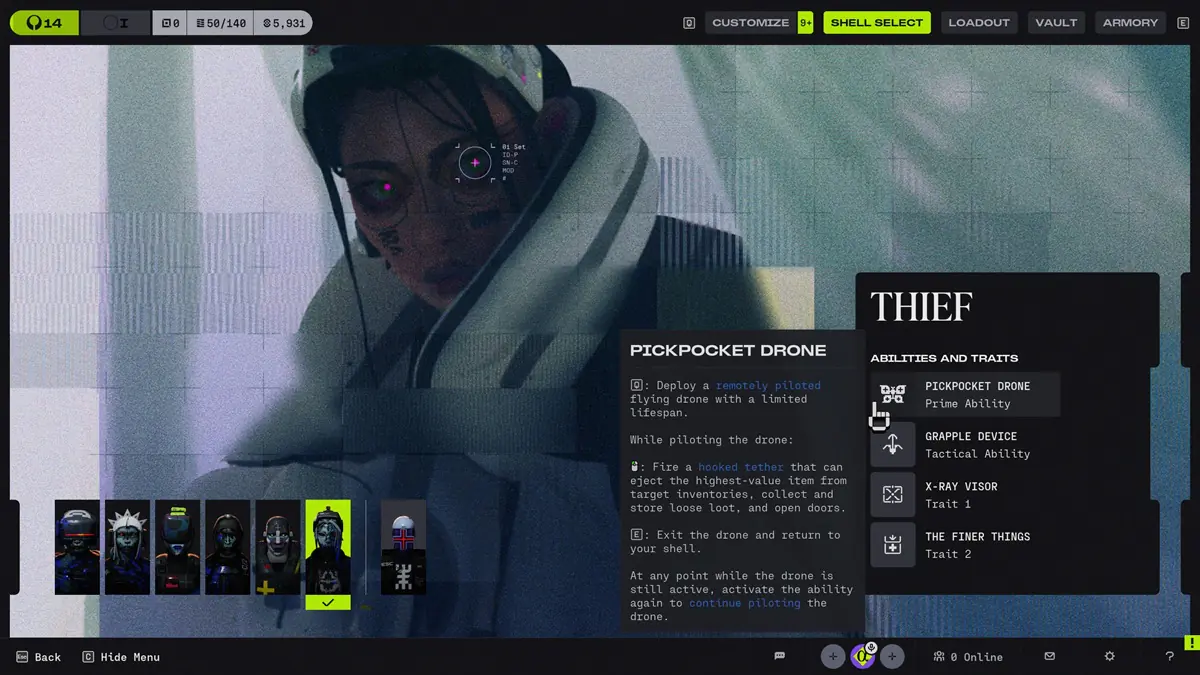
Prime abilities are essentially your ultimate, offering powerful, class defining effects on a long cooldown. Think smoke walls and enemy detection – things that can change the tide of a battle when used well. Tactical abilities on the other hand are your bread and butter, providing utility such as a grappling hook or invisibility.
At launch each of the six shells feels distinct and broadly useful, though not all are created equal. Sweaty players have already gravitated heavily to Recon – a shell with one of the strongest Prime abilities. She has the enemy detection Prime mentioned previously, but crucially she also has the direct counter to that. One of her passive traits alerts you when an enemy Recon has pinged you, meaning you’re not likely to be caught unawares.
Otherwise, most of the other shells feel good, and have a role within a three-man team. Destroyers are both the tank and a heavy damage dealer, Assassins can cut up teams on a flank or retreat to revive once danger passes and the Thief can cause mayhem with her loot-stealing drone. Triage, the medic shell, feels a little out of place though. While useful on paper – he has drones that provide healing and can revive a fully dead player from a considerable range – he just doesn’t have a place within the game’s moment-to-moment gameplay. By far the worst launch shell though is the Vandal. Many players have gravitated to her immediately as the e-girl uwu shell, but sadly the utility she provides both herself and the team is severely underwhelming by comparison.
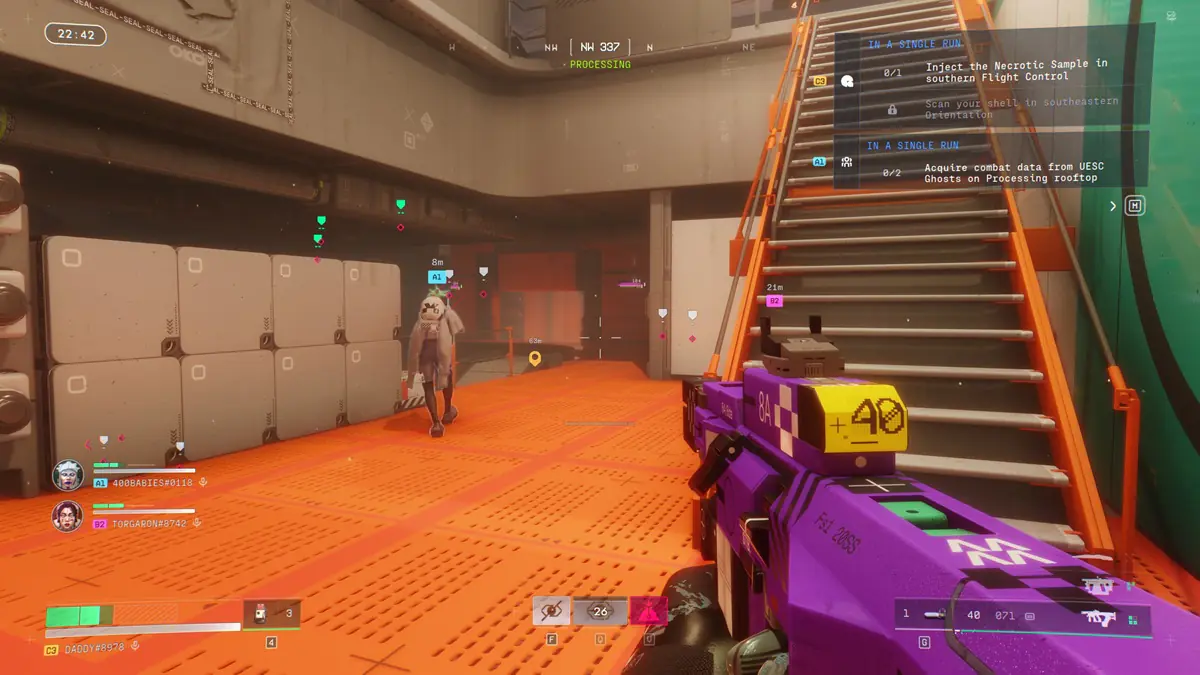
Visually, Marathon features some stunning highs and some hellish lows. The design language itself is robust. Take for instance the weapons and the UESC bots, both blocky and spartan in their style, suggesting at their connection. These are instruments made for destruction and death, and they take their cues appropriately. In contrast, buildings and healing items are smooth and made of flowing designs.
Appropriately, the Runner shells are the combination of both. Their bodies are a blend of soft, long lines contrasted with sharp edges to hint, subconsciously, that you’re playing as someone who cuts the line between those two worlds.
While the design team undoubtedly worked wonders on the world, the same cannot be said for those in charge of the UI. Frankly, it’s a mess. Form over function, style over substance and however many other of those overused phrases you can think of. It’s impossible to tell at a glance what half of the contents of your vault actually do, as many items within a category look functionally identical.
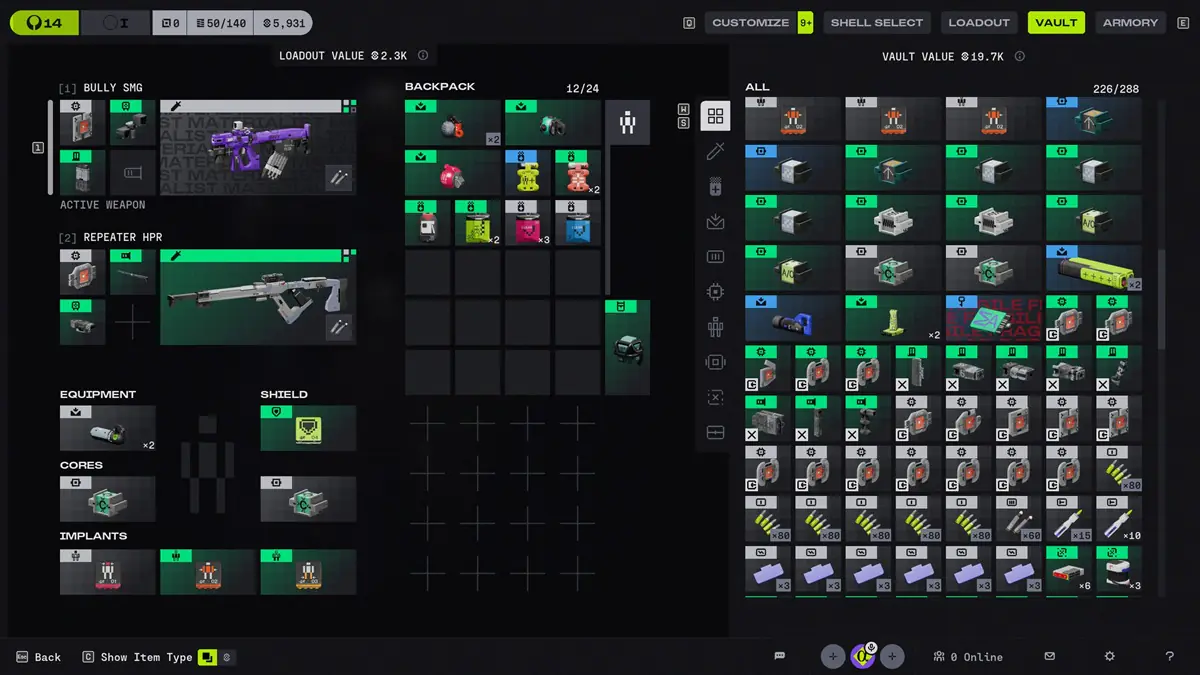
Many of these items provide various stat bonuses, but without any contextualisation of what they mean. Sure, there are bars and they have cute green or red numbers sometimes but I can almost guarantee you that 99% of the player base is not engaging with that – firstly, because it’s obfuscated, and secondly because there’s no greater context as to what these numbers mean.
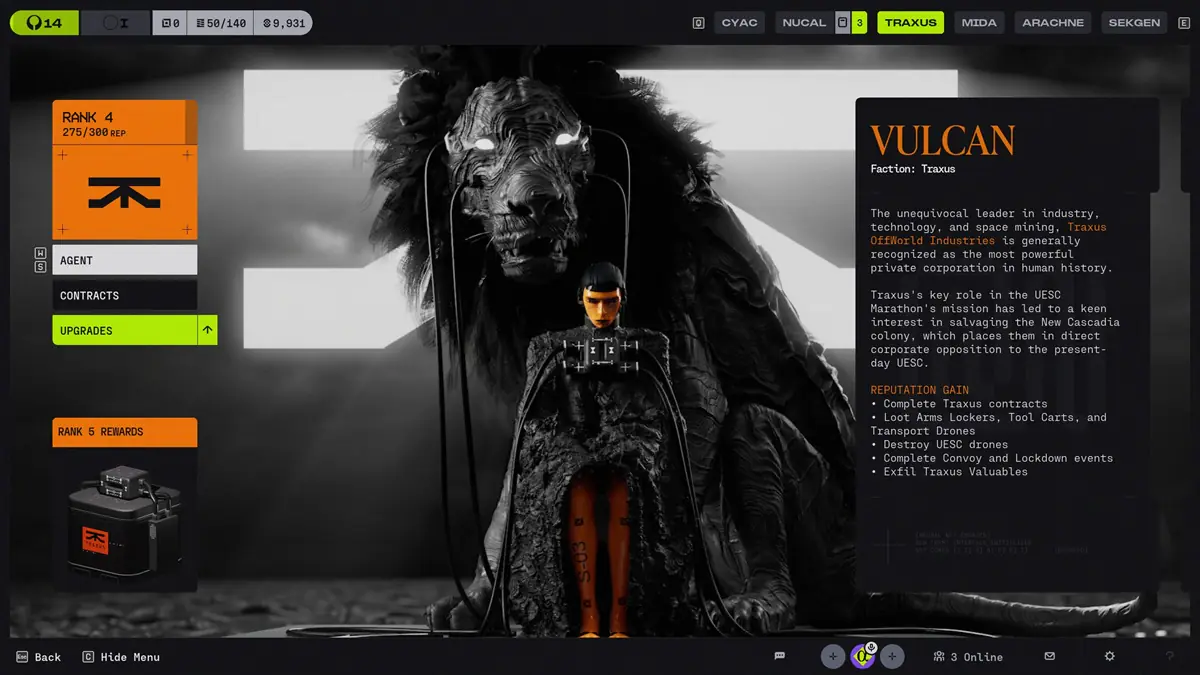
Then of course there’s the menu navigation in general. It’s a nightmare flicking around between various sub-menus, sorting out your loadout and vault and even just staring at a grayscale upgrade tree for one of the game’s six factions. Nothing is intuitive. Even after my first ten hours, I still have to bounce in and out of menus to find what I’m looking for.
Sadly, and perhaps most damningly, some of this undercooked visual design has made its way in to the map design too. Perimeter feels dead – not in the good way that you’d want a map like this to feel, but in an empty, half cooked way instead. Dire Marsh is better, with some interesting areas and landmarks but it pales in comparison to any map in Arc Raiders. There’s so much focus on where Bungie expects you to be that the between areas feel like a lifeless void.
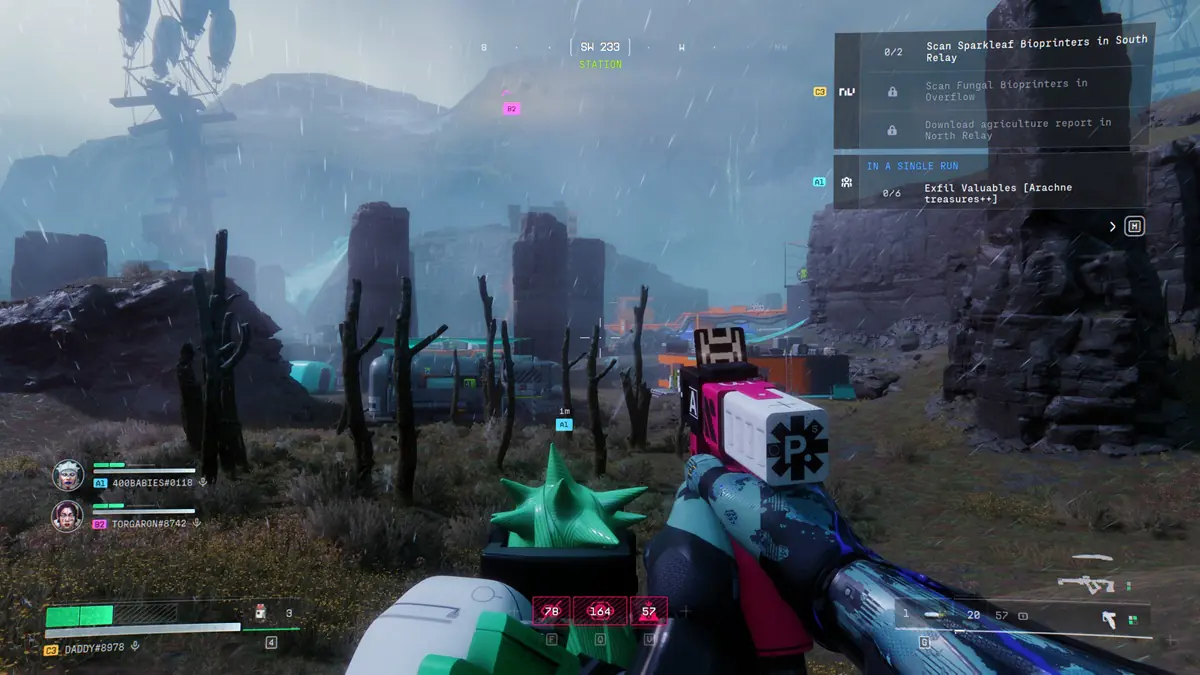
Even Outpost, the map that serves as the toughest challenge at time of writing, suffers from some whack design choices that reduce readability. It’s one thing to create an aesthetic and stick to it, but at some point someone has to rein the artists in and prioritise gameplay.
Thankfully Bungie has redeemed itself on the gameplay side. While the gunplay is a little lacklustre – something Bungie usually excels at, oddly enough – there are some meaningful reimagining’s of extraction shooter staples to be found here. There’s no crafting, so you only need a couple of different materials rather than a billion random ones, and valuables are automatically sold on exfil.
Then there’s progression – traditionally you would only really progress upon a successful extract, but Marathon tosses that aside. Now you’re always earning progression and experience, regardless of whether you make it out or not. That’s because each of the six factions understands that you’re going to die. Often. And so, they reward you for the actions you achieve each run rather than just for making it out.
The biggest change though is that death, truly, is not the end. So often in extraction shooters it all ends in seconds. The 10 minutes of prep work, the 15 minutes crossing the map carefully, all undone by a rat sitting at extract or another team passing at just the wrong moment. Not in Marathon though – as long as one of your trio survives, death is only a temporary condition. One that you can be revived from even when finished. Just don’t expect to have all your gear though.
Things certainly aren’t perfect with Marathon at launch, but Bungie is definitely cooking. Some balance touch ups and some UI/UX optimization will go a long way to easing a lot of the troubles I’ve had through my initial impressions. Unfortunately, being a long time Destiny player, I don’t have much faith in Bungie to actually get this right.
While Marathon hasn’t grabbed me yet, I’m going to keep plugging away at it before bolting a score on to this review and calling it a day. There’s a lot here, most of it good, and as long as Sony backs Marathon through this teething phase I think we could have a gem on our hands – with some aggressive polishing, of course.
Update [25 March 2026]: Boy how a couple weeks can change things.
When I last sat down to air my thoughts on Marathon I wasn’t sold. I was past the initial rough patch and into the part where it “get’s good”, but things still hadn’t clicked. Rather than being blown away, I was simply whelmed – feeling a light to strong 7. Flash forward to now though, with 60 something hours on Tau Ceti IV, multiple Cryo Archive extracts and zero-to-hero team wipes under my belt and things couldn’t be more different.
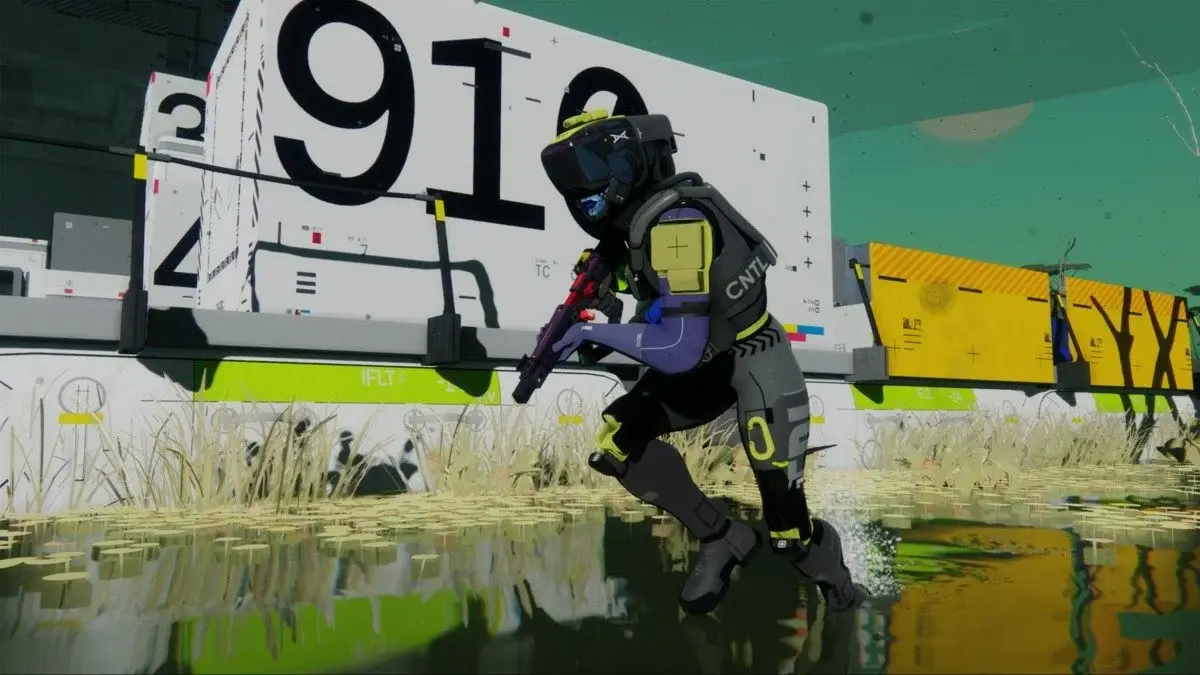
First let’s talk about the maps. With more time under my belt, and the Cryo Archive cracked open, I’m willing to admit that I can now see the vision. Dire Marsh, while being a PvP hell zone with WAY too many mid-game contracts, is a map that flows well. Buildings are varied and constructed in such a way for all shells to be able to shine. Whether you want to find action or avoid it, there’s always a way through the mud – if you’re willing to find it, of course.
Outpost is a whole other experience entirely. A PvP hotbed with great loot and more Rooks then you can poke a stick at. Mastering this map has been a joy, learning which keycards you need to whip around and collect to open up Pinwheel and quickly gain access to the Pinnacle Strongbox.
Then, of course, there’s the jewel in the crown. Cryo Archive.
From the moment you first spawn in, you’re assaulted by waves of tough bots and faced with locked doors wherever you look. Any brief respite you may find in the cacophony of your own battles is haunted by the not-so-distant sound of another team doing just what you are, and you’re reminded that the true biggest threat is only one or two doors away. It’s no understatement to say that this is not only the best map Bungie have put out to date, but almost certainly the best in any extraction shooter.
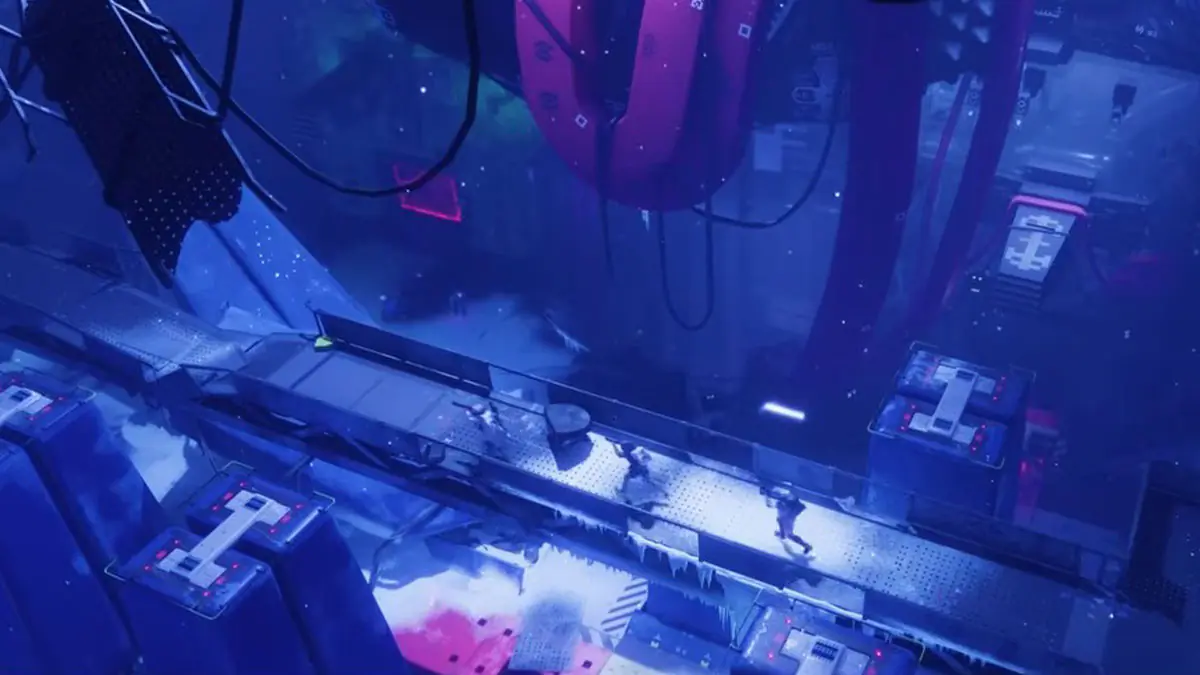
I absolutely stand by my criticism of Perimeter though. It’s genuinely such an ugly map that it doesn’t fit in with the other three at all. With Perimeter playing host to both the Duos mode and Ranked this past weekend, I’ve spent many many hours tussling with other teams at Overflow and I am sick to death of the brown, boring and bland transition zones.
I could write a whole other review on just how much I’ve come to adore Marathon. The gentle patter of rain, the falling rocks that sound like footsteps. The designs of the guns and the sounds they make. There’s genuinely so much excellence here that I can’t help but lament the troubled path Bungie took to get here. From art theft to layoffs, and perhaps the greatest sin in the eyes of their community – leaving Destiny 2 out to die.
Now, with a vocal minority of chuds jeering for its demise, Marathon faces a pivotal moment. Will Sony allow it to blossom into the magnificent game it can be? Can Bungie resist the urge to be their own worst enemy, and stay true to the course they’ve charted? Time will tell.
What I can tell you though is that, without a doubt, Marathon is not only the best extraction shooter available right now by a wide margin, but also one of the premier PvP experiences out there. It’s a must buy for anyone who enjoys thrilling PvP combat.
Don’t miss it.
Marathon was reviewed using a promotional code on PC, as provided by the publisher. Two additional codes were provided on PS5 to supplement coverage. Click here to learn more about Stevivor’s scoring scale.
 |
Marathon6 March 2026PC PS5 Xbox Series S & X
|
This article may contain affiliate links, meaning we could earn a small commission if you click-through and make a purchase. Stevivor is an independent outlet and our journalism is in no way influenced by any advertiser or commercial initiative.