















An epic of (truly) epic epicness.
I was obsessed with real-time strategy games as a kid, and when I hit my teens I gained an intense love for tabletop wargames and Civilization. I find myself firmly in the back-half of my 30s now, which feels just about bang on time for a foray into the world of historical grand strategy games.
The sheer notion of starting from scratch in this world with something as staggeringly complex as one of the vast history sims Paradox Interactive is known for felt wildly intimidating, especially as they run in real-time and not on a turn-by-turn basis. Lucky for me, Europa Universalis 5 turns out to be the perfect entry point with just how gently it guides players in.
The tutorial actually begins with Europa Universalis 5’s entire in-game user-interface removed and bleeds it back in section by section as it explains what each part does. It’s still a hell of a lot to take in though, and I confess that I ran that tutorial through more than once before I really started to get to grips with any of it.
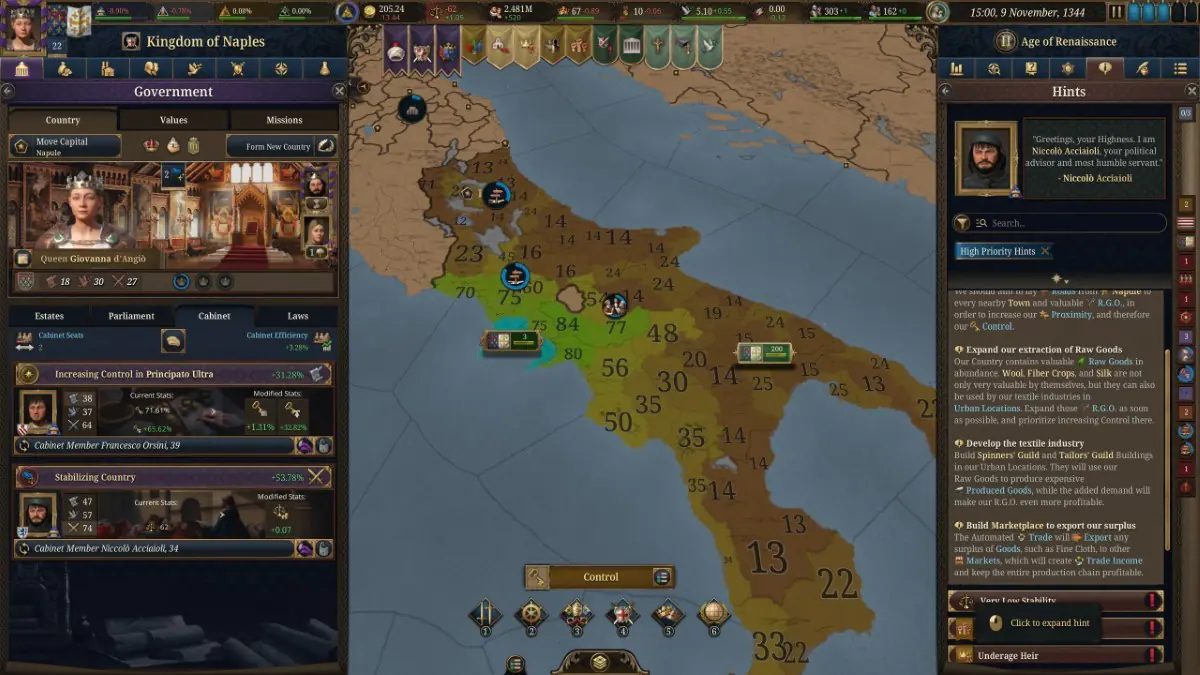
Regardless, I still think it does a pretty great job of nailing the balance between being thorough but not off-puttingly overloading. There’s a solid contextual hint system as well as powerful automation tools that are always on hand too, each of which the tutorial wisely guides you towards so as to get you up and running as quickly as possible. On the whole it does a pretty terrific job of letting you learn deeper gameplay specifics as either they arise or as you’d personally care to learn them.
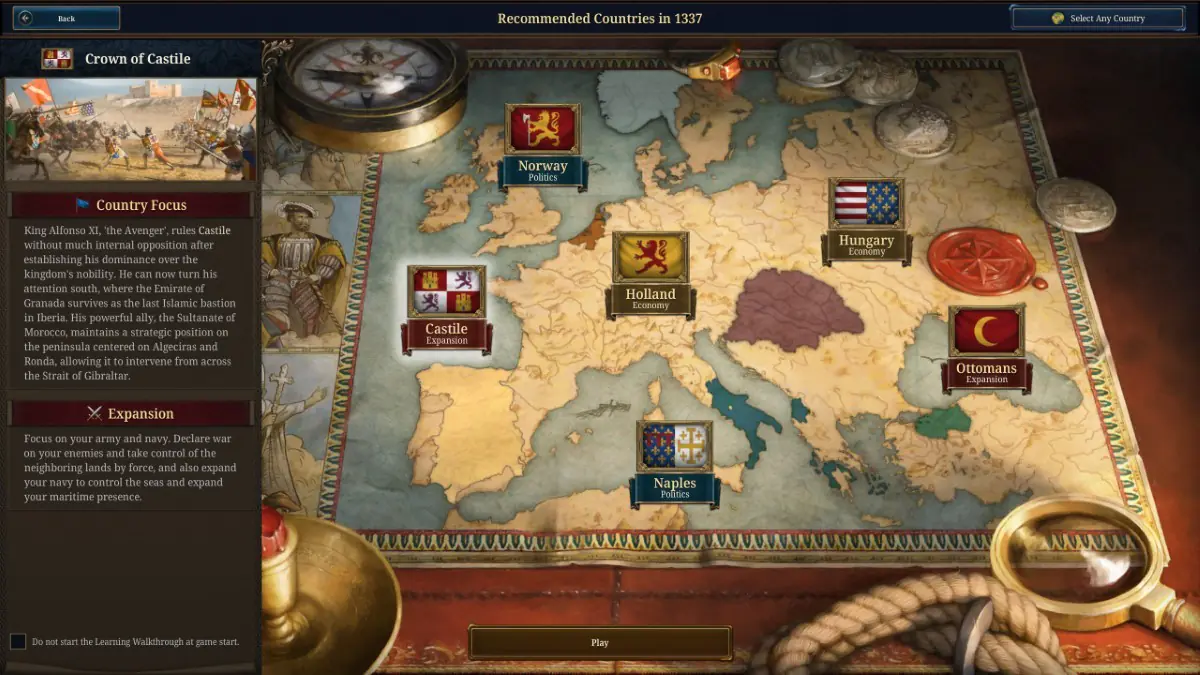
Though you’re free to play as any of hundreds of nations from across the globe, Europa Universalis 5 suggests six specific European ones for beginners due to their power, stability, and breadth of things to actually do. Each has either a political, economic, or expansionist gameplay bent, and when chosen, will give a good outline of what your goals should generally be when playing as them.
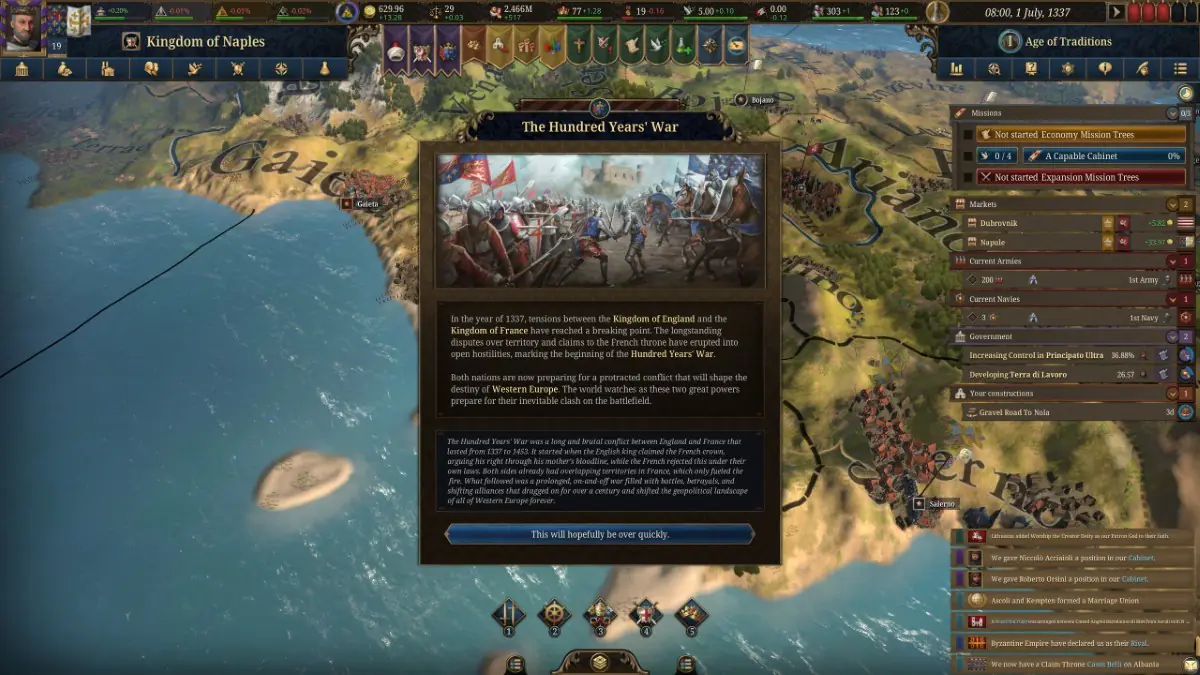
I first tried Naples who sport a political focus, but I quickly found their whole situation both a bit too complex and boring when married with trying to learn the ins and outs of the game itself. I then decided to switch over to the expansionist Ottomans who I instantly vibed with.
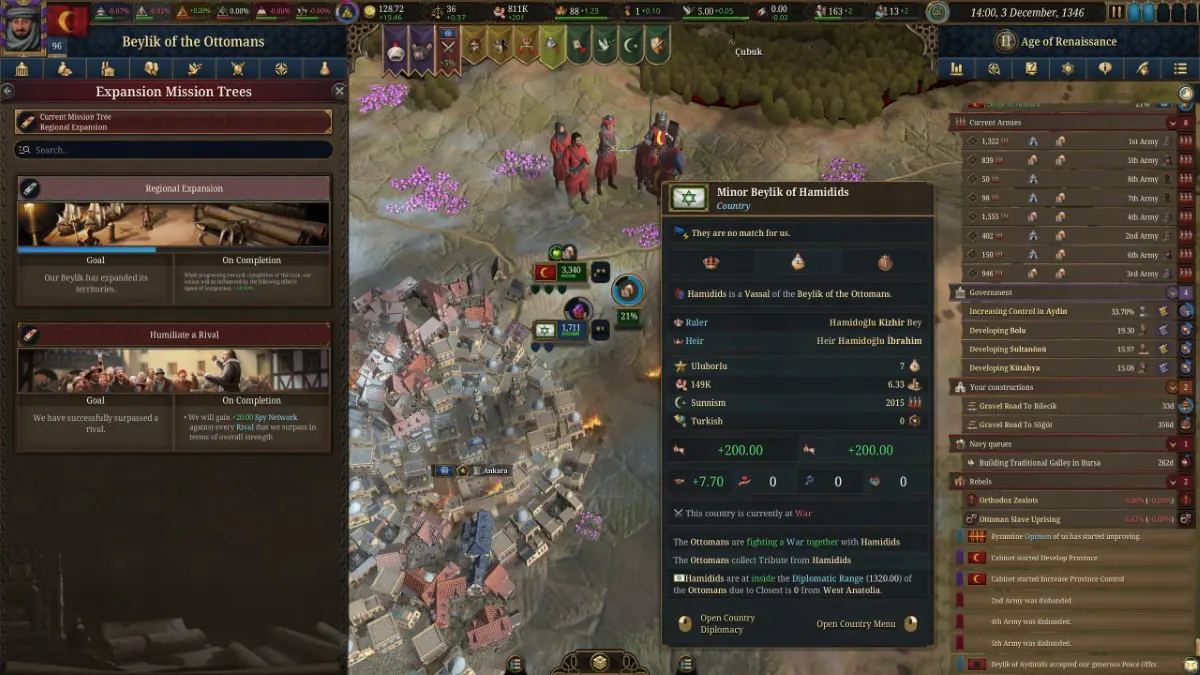
Despite the aforementioned goals as to how your chosen starter nation should play, Europa Universalis 5 doesn’t actually present the player with any specific win state to shoot for in the ways that something like Civilization does. At first this was a little weird for me to wrap my head around, but as the hours ticked by I realised that the loosely historically guided sandbox of it all is truly where the magic of these kinds of games lies. It’s a canvas for setting your own goals and becoming engrossed in the stories that result from the pursuit of them, and boy will you become engrossed.
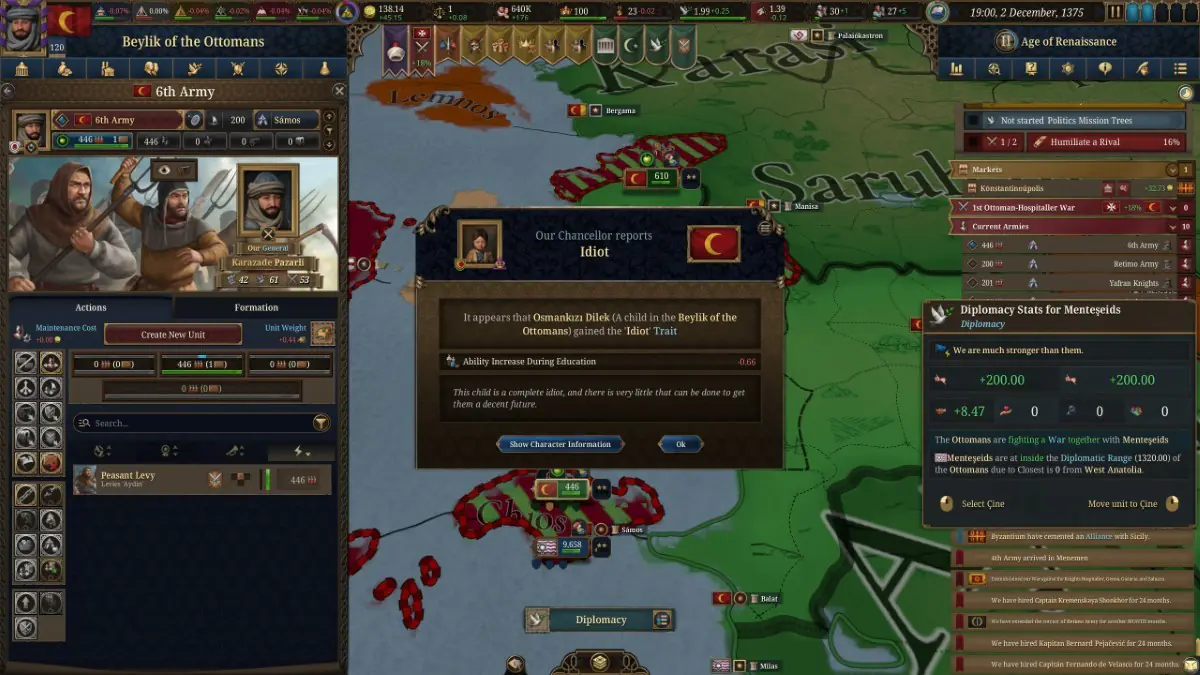
My first few decades in control of the Ottomans kicked by unremarkably. A cousin or two died of dysentery, my second-born son was growing up to be something of a bumbling idiot, the Hundred Years’ War kicked off on the other side of the continent, but nothing especially seismic.
After enduring several in-game years of antagonism from the nation-state of the Knights Hospitaller however, I finally decided that it was time to turn their lovely lands into a new Ottoman peninsula. I leaned on the casus belli their vocal hostilities had so graciously gifted me, raised my levies, swiftly trained some professional soldiers to bolster their ranks, and marched west.
The Knights were a breeze to crush, made all the easier by a large segment of their own unhappy people deciding now was the opportune time to rebel and form their own nation inside their lands.
The Knights had an ally in the Republic of Genoa though, across the Mediterranean sea. They commanded a mighty navy, but I had superior armies bolstered by well-paid mercenaries. The Genoese lacked the manpower to take my lands but I couldn’t pierce their coastal blockades.
Eventually I had no choice but to push for peace, sacrificing some of the lands I’d taken in negotiations, as the war was taking too much of an economic toll on my once flushed nation. The Knights were effectively finished as a minor global power regardless as their own rebel faction had claimed dominance over the lands I relinquished while brokering a treaty.
When my economic and political position had stabilised a few years later, I began to set my sights upon the great prize just across the border, Constantinople (not Istanbul). I used my diplomatic muscle to quietly establish a spy network over the course of several in-game months.
When they were discovered before becoming fully operational, I decided to throw caution to the wind and went to war with them without a publicly justifiable reason. This opened a whole can of worms as an alliance of several European powers then formed against me as their increasing discomfort at my general aggression grew too much for them to bear.
One such nation laid north across the Black Sea, and it was then I saw an even juicier opportunity to grab land. I fortified my homelands, raised enough naval levies to sail north and blitzkrieged my way across the sparsely populated and entirely undefended Crimean peninsula, capturing it entirely within a matter of in-game months.
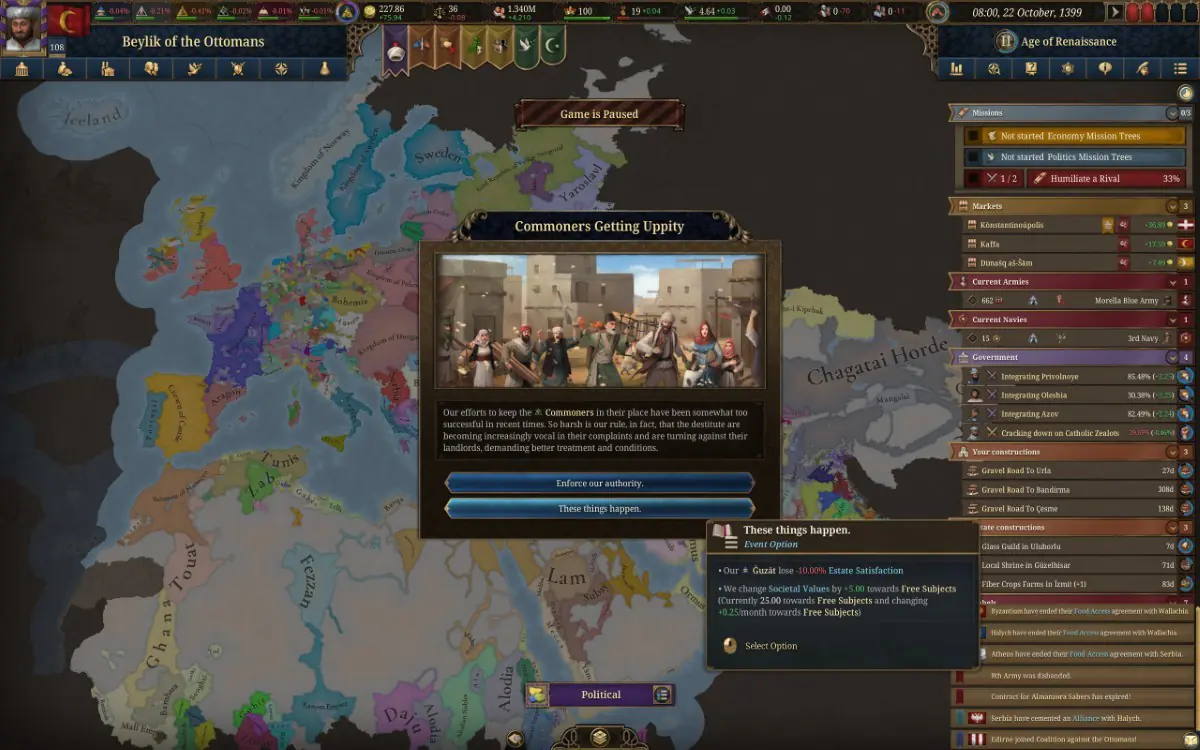
I then felt existentially terrible about the whole thing, made worse by the fact that I cannot even recall the name of the nation I ground to dust in my lust to expand and surely couldn’t even have told you in the moment.
Despite the staggering depth and vast complexity of its empire management systems, the true power of Europa Universalis 5 is as an engine for deeply compelling emergent storytelling.
After 43 hours I still feel as if I’ve barely scratched the outer atmosphere of the exterior shell of Europa Universalis 5’s surface. I’m still relying heavily on its aforementioned automation systems to control most aspects of my economies and the entirety of my city building, but I’m having such a ball keeping focused on the politicking and military aspects that I’m in no rush to learn that whole side of things anyway.
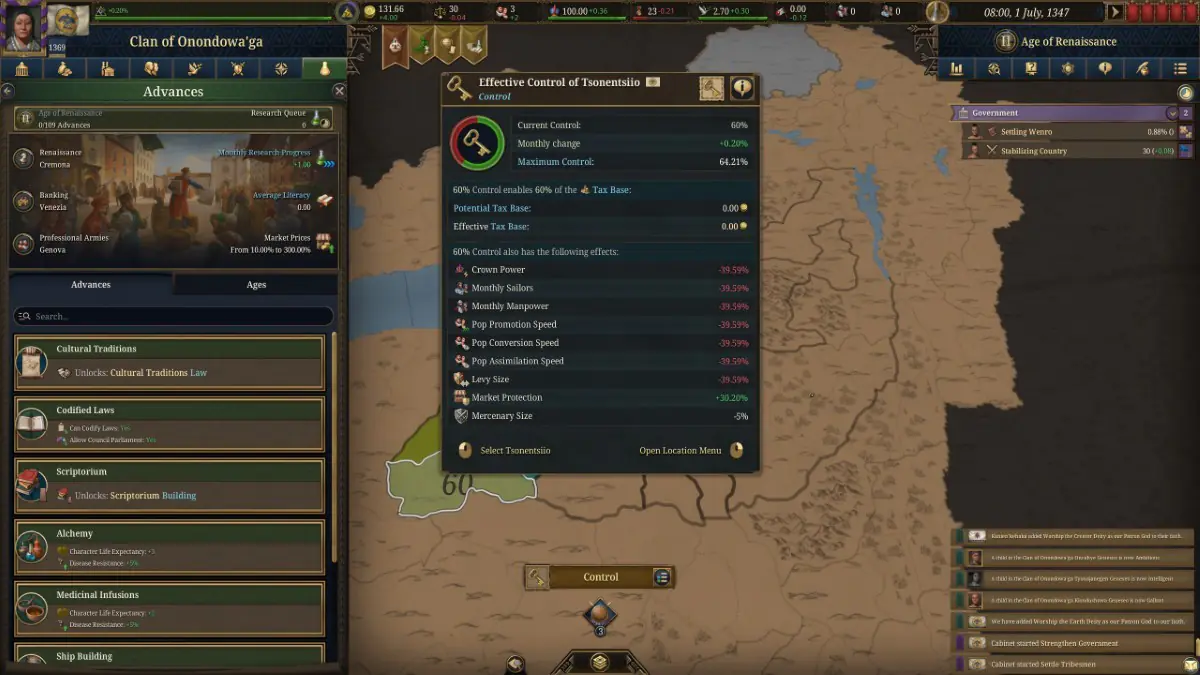
The automation options being as customisable as they are fills me with confidence that I could get to grips with the intricacies of trade, population, and land management though when I’m ready to do so though. On the flipside, I’m fascinated to try turning every automation option possible on, picking a random nation, and letting it play almost like an idle game.
If it sounds as if I’ve become pretty obsessed with Europa Universalis 5 then well, yes, I have. It’s not without its issues though.
Despite sporting a good tutorial, a decent hint system, and a searchable in-game encyclopedia, Europa Universalis 5 isn’t always good at explaining how systems and mechanics fundamentally work as they arise. For example, I researched the advancement that enables me to establish colonies but the tooltipping for it all basically stopped there. Is colonisation an act of the cabinet? Is it something my diplomats do? Is it a function of the casus belli system? I still have no idea!
More frustratingly, I experienced extremely frequent crashes during the review period. My PC is admittedly on the lower-end of its surprisingly high minimum requirements though, despite being a pretty high-end gaming laptop purchased less than two years ago.
Several large patches dropped over the past ten or so days that I’ve had with the game, none of which have helped matters. A whopper of a patch landed overnight though also and in the three or so hours I was able to test it today it remained stable and didn’t drop to desktop once, so hopefully whatever my issue was has been dealt with.
I feel it’s worth noting too that while a small number of indigenous North American tribes are playable in Europa Universalis 5, zero from Australia or New Zealand are. As the whole game is played from the point of view of what was more or less the known world from the year 1337, I do sort of get why. It still lends the whole thing a rather distasteful terra nullius edge though.
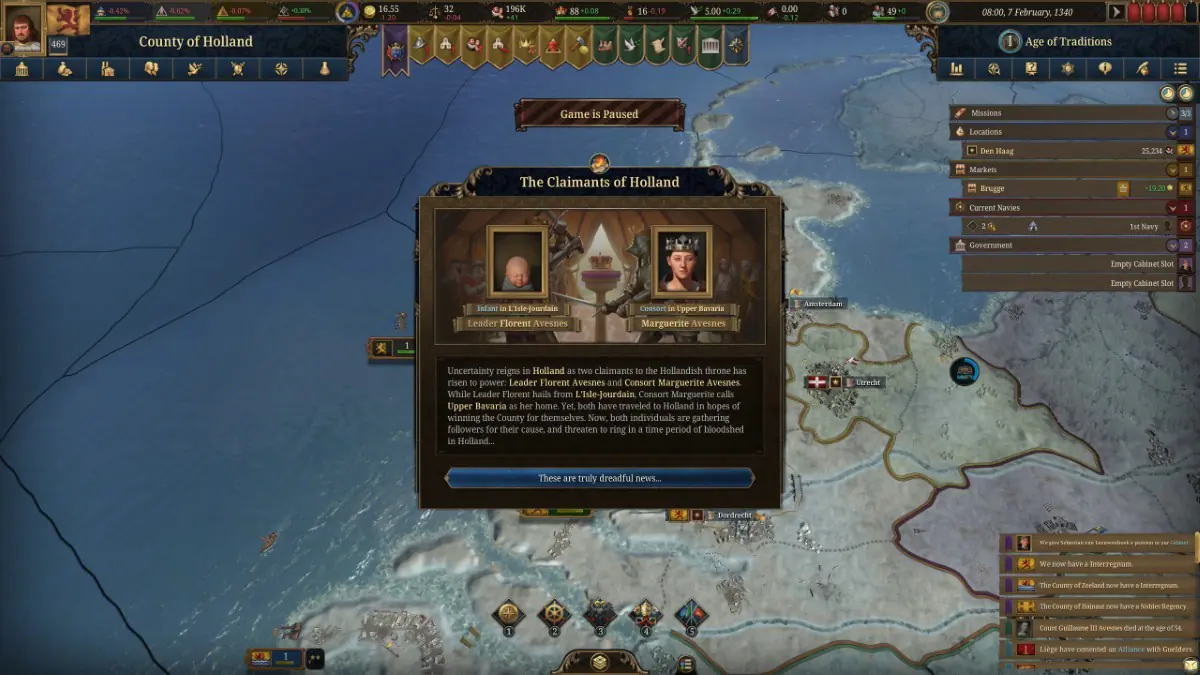
Issues aside, Europa Universalis 5 has been an utterly incredible introduction to a whole new gaming world for me. It’s wonderfully welcoming yet entrancingly absorbing, and I can’t recommend it enough to anyone interested in getting into the grand strategy genre.
Europa Universalis 5 is available from 4 November on Windows PC.
Europa Universalis 5 was reviewed using a promotional code on PC provided by the publisher. Click here to learn more about Stevivor’s scoring scale.
This article may contain affiliate links, meaning we could earn a small commission if you click-through and make a purchase. Stevivor is an independent outlet and our journalism is in no way influenced by any advertiser or commercial initiative.